

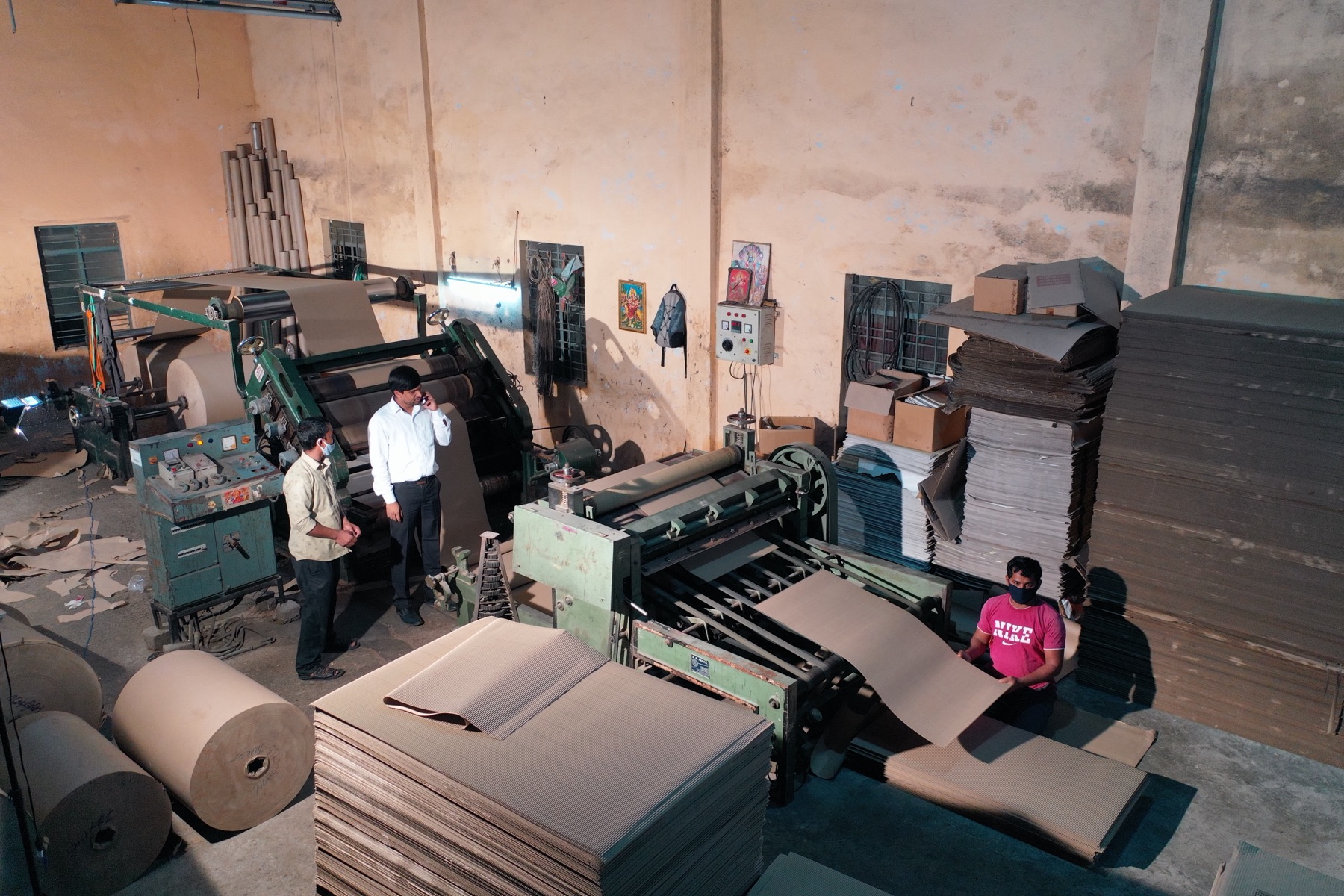
Choose a 3-ply corrugated box for light, single-layer retail or e-commerce packs, a 5-ply box for heavier contents or boxes stacked several high, and a 7-ply box for heavy industrial goods, tall stacks and long export journeys. Confirm the choice with a box compression (BCT) requirement worked out from the load on the bottom box.
Key points
- 3-ply has one fluted layer, 5-ply has two and 7-ply has three, each between flat liners.
- Stacking strength (BCT) matters more than burst strength for most warehouse and transport failures.
- Humidity and time under load can cut box strength sharply, so safety factors are large.
- Board grades and flute profile change strength as much as ply count does.
- Specify a test result, not only a ply number, and the supplier can design the cheapest box that passes.
What does 3-ply, 5-ply and 7-ply mean in a corrugated box?
Ply is the number of paper layers in the board. A 3-ply board has two flat liners with one fluted medium between them; 5-ply adds a second flute and a middle liner; 7-ply adds a third flute and liner.
The liners are usually kraft liner or kraft paper, and the fluted layers are lighter kraft paper formed into waves on a corrugator and glued to the liners. Each extra flute-and-liner pair adds thickness, stiffness and compression strength, along with weight and cost. You can read more about how the board is built under corrugated board.
How do flute types affect corrugated box strength?
Taller flutes give more stacking strength and cushioning; shorter flutes give a flatter print surface and better puncture resistance. The flute profile is part of the specification, alongside the ply count.
Common profiles, from tallest to smallest, are A, C, B and E flute, with approximate heights of about 4.5–5 mm, 3.5–4 mm, 2.5–3 mm and 1–1.5 mm. In India, B and C flutes are common for shipping boxes, and 5-ply boards often combine two profiles, such as B and C, to balance print quality and strength. E flute is used for retail and display packs where print matters. Exact heights vary by corrugator, so take them as typical.
Board grades matter as much as ply count. A 5-ply box made from low-BF papers can be weaker than a well-built 3-ply box with strong liners. When you compare quotations, ask for the GSM and burst factor of each layer, from outer liner to inner liner, so that you are comparing like with like.
Which ply should I choose for my product?
Start from contents weight, stack height and route, then pick the lightest construction that meets the compression requirement. The table gives a rough first choice to discuss with your supplier.
| Situation | Typical construction | Typical uses | Check before ordering |
|---|---|---|---|
| Light contents, little stacking | 3-ply, B, C or E flute | Retail packs, e-commerce parcels, garments, light food items | Burst or edge crush adequate for courier handling |
| Moderate weight or several boxes high | 5-ply, often B and C flute | FMCG shippers, appliances, bottles, pharmaceutical cartons | BCT from stack load with humidity safety factor |
| Heavy contents, tall stacks, export | 7-ply, multiple flutes | Machinery parts, heavy industrial goods, long sea freight | BCT, puncture, and pallet pattern |
| Humid storage or cold chain | Step up one level, or higher-grade liners | Fruit, dairy, frozen food, monsoon storage | Cobb limit, moisture range, conditioned BCT |
Rough rules of thumb often quoted in the Indian trade put 3-ply boxes at light loads of a few kilograms, 5-ply at moderate loads up to roughly 20 kilograms and 7-ply above that. Treat these as starting points only; stack height and humidity can move a product up a level.
What is the difference between BCT and burst strength?
Box compression strength (BCT) is the top-to-bottom load a box carries before it buckles, which predicts stacking performance. Burst strength is the pressure needed to rupture the board face, which relates more to rough handling and contents pressing outwards.
Most box failures in warehouses are crushing at the bottom of a stack, so BCT is usually the more useful figure. Burst strength is easy to test and widely used in India, and paper is often bought by burst factor, but a high-burst board can still have mediocre compression if its flute or liners are weak in edge crush. BCT depends on the board’s edge crush resistance, the board thickness and the box perimeter, so a larger box of the same board carries more load than a small one. Both tests should be done on conditioned samples to the method agreed in the specification.
How do I work out the stacking strength a box needs?
Calculate the load on the bottom box, then multiply by a safety factor for humidity, storage time and handling. The result is the minimum BCT to put in the specification.
- Weigh one filled box, including inner packs.
- Find the number of boxes stacked above the bottom one, in the warehouse and in transport.
- Load on the bottom box = weight of one filled box × number of boxes above it.
- Choose a safety factor. Factors of 3 to 5 are common, higher for humid climates, long storage, poor pallet alignment or overhang.
- Required BCT = load on the bottom box × safety factor.
Worked example: a 12 kg box stacked eight high has seven boxes above the bottom one, so the static load is 84 kg. With a safety factor of 4, the bottom box needs a BCT of about 336 kgf, roughly 3.3 kN. That is a typical 5-ply requirement for a medium-sized box, though the final construction depends on box size and board grades.
How do humidity and transport affect corrugated box strength?
Paper absorbs moisture from the air, and corrugated boxes lose a large share of their compression strength in very humid conditions. Long periods under load also weaken boxes through creep.
Monsoon storage, refrigerated rooms and container voyages are the usual problems. Specify a moisture content range for the board, a Cobb value limit for liners exposed to condensation, and ask for BCT tested on conditioned samples. Transport adds vibration and impacts, so boxes for long road journeys or export need more margin than boxes going from factory to a nearby warehouse. Poor stacking, such as boxes overhanging the pallet edge or column stacks out of line, can cost a large share of a box’s strength regardless of ply.
What should I put in a corrugated box enquiry?
Send dimensions, contents, ply and flute (if known), board grades and a performance requirement. If you are unsure about ply, send the weight, stack height and route and let the supplier propose a construction.
An example enquiry line: RSC box, inner 400 × 300 × 250 mm, 12 kg contents, stacked eight high on pallets, domestic road transport, monsoon storage; 5-ply B/C flute suggested; minimum BCT 3.3 kN on conditioned samples; one-colour print on two panels; 10,000 boxes a month. The full list of lines is in writing a corrugated box specification.
Bollant makes ply corrugated boxes, solid board boxes and printed packaging on its converting lines from recycled board, and agrees ply, flute, board grades and compression or burst requirement per order. See corrugated and solid board boxes and the wider packaging solutions range. A box compression or burst test for the agreed construction is available on request.
Frequently asked questions
What is the difference between 3-ply and 5-ply boxes?
A 3-ply box has one fluted layer between two liners; a 5-ply box has two fluted layers and three liners. The 5-ply box is thicker and carries considerably more stacking load, at higher weight and cost.
How much weight can a 5-ply corrugated box hold?
It depends on box size, board grades, flute and stacking. Trade rules of thumb put 5-ply boxes at moderate loads up to around 20 kg, but the reliable answer comes from a BCT requirement calculated from your stack load.
When do I need a 7-ply box?
For heavy contents, tall stacks, long storage under load or long export journeys, where a 5-ply box cannot meet the required compression strength with a sensible safety factor.
Is BCT or burst strength more important?
For stacking and warehouse storage, BCT is usually more important. Burst strength relates to rough handling and internal pressure. Many buyers specify both.
Which flute is best for printing?
Smaller flutes such as E and B give a flatter surface and sharper print. Taller flutes such as C and A give more cushioning and stacking strength.
Why do corrugated boxes collapse in the monsoon?
Paper absorbs moisture from humid air and loses much of its compression strength, and boxes under constant load also creep over time. Design with a larger safety factor and specify moisture and Cobb limits.
What is the difference between corrugated board and cardboard?
In everyday speech "cardboard" is used for both. Corrugated board has a fluted layer glued between flat liners, while solid board or paperboard is a single flat sheet. The fluted structure gives corrugated board far more stiffness and cushioning for its weight.
Can Bollant make printed corrugated boxes to my size?
Yes. Bollant makes ply corrugated and solid board boxes, plain or printed, on its own converting lines from recycled board, with ply, flute, board grades and the compression or burst requirement agreed per order. A box compression or burst test for the agreed construction is available on request.
Bollant Industries · Published 2026-11-15

