

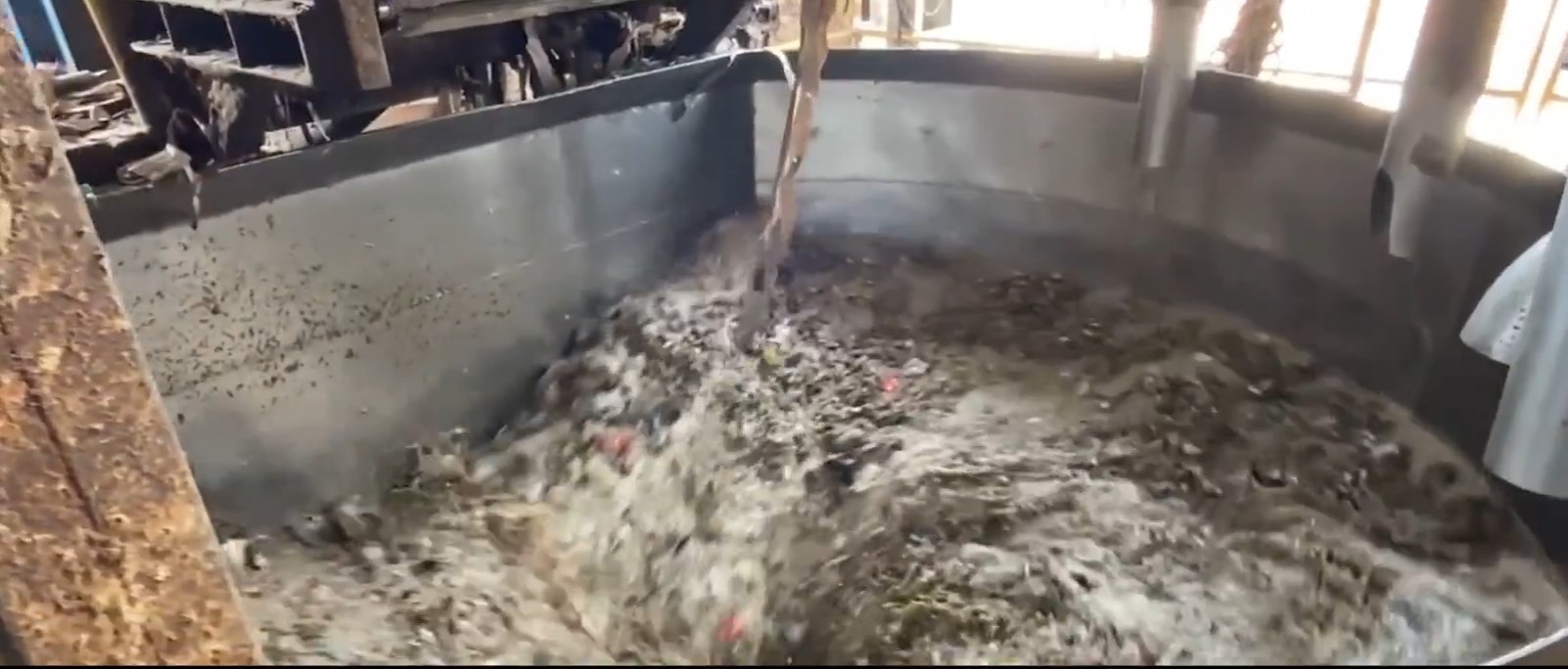
Recycled kraft paper is made by sorting waste paper and board into grades, breaking it into fibre and water in a hydro-pulper, screening and cleaning out contaminants, refining the fibre, then forming a wet sheet on a wire, pressing and drying it, and winding it into reels that are slit to width and tested.
Key points
- The raw material decides the ceiling. Old corrugated boxes give longer, stronger fibre than mixed office or newspaper waste.
- Cleaning removes plastic, metal, sand and stickies. What it misses shows up as holes, specks and web breaks.
- Refining and forming set strength and evenness; pressing and drying set density, moisture and curl.
- Reeling and slitting decide whether a reel runs cleanly on your corrugator or tube winder.
- Every stage leaves a measurable trace, so a good specification names the parameters each stage controls.
What are the main stages of making recycled kraft paper?
There are nine practical stages: collection and grading, hydro-pulping, screening and cleaning, refining, forming, pressing, drying, reeling and slitting, and quality checks. Mills group them differently, but the sequence is the same everywhere.
At Bollant’s two mills, Pochampally and Jeedimetla, the company describes the route as graded, hydro-pulped, cleaned and refined, then formed, pressed and dried on PLC-controlled paper machines before reeling and cutting to order. Its six-stage production process continues from the reel into converting, where the paper becomes boxes, cores and tableware. The table below maps each stage to what it means for someone buying the paper.
| Stage | What happens | What it decides for the buyer |
|---|---|---|
| Collection and grading | Waste paper is sorted by type and baled by grade | Strength ceiling and consistency between lots |
| Hydro-pulping | Bales are slushed with water into a fibre suspension | How much contamination enters the system |
| Screening and cleaning | Screens and cleaners remove plastic, metal, sand and stickies | Specks, holes and web breaks |
| Refining | Fibres are mechanically treated to improve bonding | Burst and tensile strength, drainage, porosity |
| Forming | Stock is spread on a moving wire and drained | GSM evenness across the width |
| Pressing | Felts and press rolls squeeze out water | Density, caliper and stiffness |
| Drying | Steam-heated cylinders evaporate the remaining water | Moisture content and curl |
| Reeling and slitting | The web is wound, then rewound and slit to width | Reel width, diameter, joins and edge quality |
| Quality checks | Samples are tested against the agreed specification | Whether the reel matches the order |
Why does waste paper have to be graded before pulping?
Because different papers carry different fibre. Grading is the cheapest point at which to control the strength and cleanliness of the finished reel.
Old corrugated containers contain long, strong fibre that originally came from kraft pulp. Newspapers and magazines bring shorter fibre, more filler and ink. Office paper gives clean but bleached fibre. A mill making brown kraft for corrugation wants a high share of corrugated waste in its furnish; a mill that pulps whatever arrives will see burst factor drift from one week to the next. Grading also catches moisture, since wet bales weigh more and pulp differently. Bollant’s own description of this step is in how recovered paper is graded, and the wider supply chain is covered in how waste paper recycling works in India.
What happens in the hydro-pulper?
A hydro-pulper is a large tank with a rotor that churns bales with water until the paper breaks back into individual fibres. The result is a dilute slurry, usually only a few per cent fibre by weight.
Pulping is deliberately gentle on the fibre and rough on everything else. Plastic film, tape, strapping and wire stay in larger pieces so they can be pulled out by a ragger rope or junk trap at the pulper. For brown kraft, the ink in printed boxes is normally carried through into the sheet, because the paper is not meant to be white. Lighter grades may add a de-inking step, which washes or floats ink particles out of the stock.
How are contaminants removed from recycled pulp?
By size and by weight. Screens remove anything larger than the screen slots or holes, and centrifugal cleaners spin out particles heavier or lighter than fibre.
A typical cleaning line has coarse screens, then fine slotted screens, plus high-density cleaners for grit, staples and glass. The hardest contaminants are stickies: small particles of hot-melt glue, pressure-sensitive labels and wax that soften in the process and deposit on wires, felts and dryer cylinders. Stickies cause holes, spots and breaks, and they are one reason a recycled mill cares where its waste paper comes from. Rejects from these stages leave the process; what Bollant does with them is described under resource efficiency.
What does refining do to recycled fibre?
Refining roughens and flexes the fibre surface between rotating bars so fibres bond more tightly in the sheet. It raises strength, at the cost of slower drainage on the wire.
Recycled fibre has already been dried at least once, which makes it stiffer and less able to bond than fresh pulp. Refining partly restores that bonding ability. Too little and burst factor falls short; too much and the stock drains slowly, the machine has to run slower, and the sheet can become dense and brittle.
How is the paper sheet formed and pressed?
The refined stock is diluted and spread evenly from a headbox onto a moving wire mesh. Water drains through, fibres lock together into a wet web, and press rolls then squeeze out as much water as possible before drying.
Forming decides how evenly fibre is laid across the width, which is where your GSM tolerance is won or lost. Some kraft and board grades are built from more than one layer, so a cleaner or stronger furnish can sit on the outside. Pressing then consolidates the web: more press load gives a denser, smoother sheet but lowers bulk and caliper.
How is recycled kraft paper dried and reeled?
The pressed web passes over a series of steam-heated cast-iron cylinders that evaporate the remaining water. It is then wound onto a large reel at the end of the machine.
Drying sets final moisture, typically in a band of several per cent for kraft, and uneven drying is a common cause of curl and of moisture streaks across the width. The machine reel is then rewound and slit into customer reels of the agreed width and diameter, on a core of the agreed inside diameter. Joins are made at this stage when a break occurs or a reel is pieced together, which is why a specification should state the maximum joins per reel. At Bollant, the paper machines run on PLC-controlled settings so they can be repeated between runs (company-stated); the mills and grades are described on the paper mills page.
Which quality checks are done on finished kraft reels?
Finished reels are checked for the parameters the buyer agreed: usually GSM, burst factor, moisture, and reel width and diameter, with Cobb value and caliper where they matter.
Samples are normally conditioned before strength testing, because paper strength changes with humidity. Ask your supplier how often each parameter is tested, on which part of the reel, and how results are reported. Bollant states that quality is checked at three points: when material is graded, at the machine, and at line-off inspection, against a specification agreed in writing before production (see quality and compliance). Test reports are issued for the grade and lot you buy, on request.
What should a buyer specify, knowing how kraft is made?
Specify the parameters each stage controls, with tolerances, and tell the mill what the paper will become. That lets the mill choose its furnish and settings instead of guessing.
- End use: liner, flute, tube or core board, wrapping or bags.
- GSM with a tolerance.
- Burst factor with a minimum or tolerance.
- Moisture range at delivery.
- Cobb value if the paper will be printed, glued in humid conditions or used in cold chains.
- Reel width, outer diameter, core inside diameter and maximum joins.
- Monthly volume and delivery pattern.
An example enquiry line: Brown recycled kraft for corrugated flute, 120 GSM ±4%, 18 BF minimum, moisture 7–9%, reels 1,400 mm wide on 76 mm cores, maximum two joins per reel, 60 tonnes a month. The figures are illustrative; your box maker or the mill can translate your box or tube design into real values. For the full parameter list, see specifying recycled kraft paper and the brown kraft paper product page.
Frequently asked questions
How long does it take to turn waste paper into kraft paper?
Inside a running mill, the fibre moves from pulper to finished reel within hours. The longer part of the cycle is upstream: collecting, sorting and baling waste paper, and storing graded bales so the mill has a steady feed.
Is recycled kraft paper de-inked?
Brown kraft for corrugation is usually not fully de-inked, because the sheet does not need to be white and ink specks are acceptable in a brown grade. Lighter and white grades need de-inking to reach their shade.
Why is recycled kraft weaker than virgin kraft?
Each time paper is recycled, fibres get shorter and stiffer and bond less well. Mills offset this with careful grading, refining and higher GSM, and strength-critical grades may need a share of long, virgin fibre.
What is a hydro-pulper?
A hydro-pulper is a tank with a rotor that mixes waste paper with water until it breaks down into individual fibres. It is the first processing step in a recycled paper mill.
What are stickies in paper recycling?
Stickies are small particles of adhesive, wax and similar material that come in with waste paper. They soften during processing and cause holes, spots and breaks, so mills remove as many as possible by screening and cleaning.
What moisture should kraft paper reels have?
Kraft is typically supplied at a moisture content of several per cent, and a buyer should agree a range rather than a single figure. Too dry and it cracks at creases; too wet and it loses stiffness and may warp.
Does Bollant make kraft paper from its own recycled waste paper?
Yes. Bollant recycles recovered paper and board at its two mills, Pochampally and Jeedimetla, into brown kraft, deluxe and news-print grade paper, duplex board and kraft liner. Their combined design capacity is around 160 tonnes a day (company-stated).
What is refining in papermaking?
Refining is a mechanical treatment that roughens and flexes fibres between rotating bars so they bond more strongly in the sheet. It raises strength but slows drainage on the paper machine, so mills balance it for each grade.
Bollant Industries · Published 2026-11-15

